Is Bad Bunny One of Us Too? Visibility and Labor
White chairs, people dancing in the streets with the joy of togetherness—a crowd like at a big wedding— Bad Bunny is giving his Grammy to ‘little self’ to show that he made it. And then, fast fashion.
For days now, there has been only one content circulating on social media. In these days when the world itself has turned into a massive fire, there are still some beautiful things happening in the flow of life. Large communities backed by imperialist powers have joined forces to turn the world into a place filled with right-wing, conservative, and unequal values. For those of us exhausted from keeping up with all this news, the fact that artists are showing resistance and speaking out about everything happening in the world brings a smile to our faces and sparks hope.
Of course, we encounter different information on our screens every day, and when we examine it through our own filter, it seems contradictory to us to see the elite of discourse shouting “eat the rich” on one hand, and then jumping into their expensive cars after award ceremonies and heading to their mansions on the other.
This is a game of visibility.
Let’s put aside what’s happening around the world (!) and turn our attention to Bad Bunny’s performance. While the Super Bowl itself is already structured to appeal to American culture, Bad Bunny’s performance here, highlighting ethnic diversity, gave us some relief. By naming all the countries on the American continent at the end of his performance, he conveyed the message that we are better together.
The performance featured many different elements. For the middle-lower class, it was possible to find traces of themselves in every minute of the performance, which is why people embraced this performance wherever they were in the world, wrapped themselves in it, filled the stands, and people from all over the world became one with Bad Bunny’s music and performance. Whether giving tips to old gentlemen playing okey on a plastic table covered with a tablecloth, waking up a child who had fallen asleep on plastic chairs during a wedding, greeting women braiding hair and doing nail art at the door entrance and glancing at them, or connecting with shopkeepers at small local businesses who constantly offered their hospitality, Benito was very much one of us. During the performance, when even the smallest details were read, Bad Bunny’s halftime show felt like a hand on everyone’s shoulder. Precisely for this reason, as soon as the performance ended, all social media was flooded with Bad Bunny content, and critics also delved deep into the cultural reading.
The cream-colored outfit Bad Bunny wore during his performance, referred to as “basic,” is interpreted as cultural representation and accessibility. Putting aside luxury brands or famous designers and dressing in a chain that everyone can afford may, at first glimpse, be read as a democratic gesture that breaks the codes of elite consumption. Benito, who made quite a splash with last year’s album “DeBÍ TiRAR MáS FOToS,” sits on a plastic chair on the album cover as if he’s about to chat with us, but amid the world’s countless uncertainties, we anxiously ask: Is Benito really one of us?
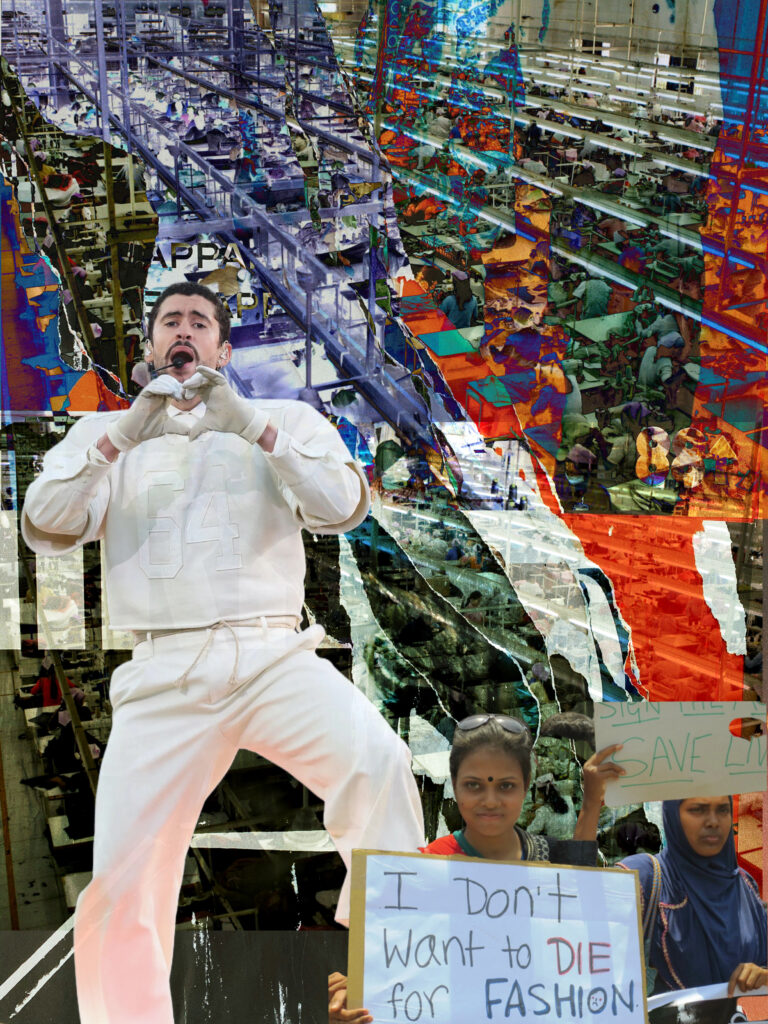
Bad Bunny wearing Zara on stage is not merely a style choice, but reveals the structural tension between representation and production. The colonized and marginalized peoples made visible in the artist’s music are, in fact, the people who often serve as cheap labor in the global production chains of the fast-fashion economy. Viewed at a cultural level, it is an anti-colonial discourse, but the material basis of the discourse remains tied to capitalist values, which raises questions in our minds.
But the real question here is: Is Zara truly a brand accessible to all people, or is there another labor regime hidden behind the rhetoric of “accessibility”?
Zara is one of the largest brands of Inditex, a multinational retail group based in Spain. Although it originated in Spain, production is not limited to a single country; rather, it relies on an extensive supply chain spanning Europe, North Africa, and Asia. This structure is directly related to the flexible, fragmented, and low-cost labor system of the fast-fashion industry. Precisely for this reason, while an anti-colonial representation is established in the stage performance, the fact that the material object enabling this representation is produced within the global capitalist exploitation of labor confronts us with one of the most fundamental paradoxes of popular culture today. Fashion commentators emphasize that this choice can be interpreted in terms of both accessibility and the redefinition of power relations in popular culture; that is, by wearing a relatively more accessible brand at Levi’s Stadium, where thousands of people participate, is the artist moving beyond the elitist fashion sphere to become a more accessible artist?
However, every claim of equality established at a symbolic level does not find the same counterpart in the material realm. Fast-fashion brands have long been at the center of debates on workers‘ rights, sustainability, and labor exploitation. Therefore, the choice of Zara is not merely a “pro-people” style preference; it is also a political sign that reminds us of the invisible labor networks of global capitalism.
Who/what keeps this brand afloat? Who does the work, who gets the profits?
The invisible labor of the global production chain often remains far from the spotlight. While Latin America, the migrant experience, and cultural resistance become strongly visible in Bad Bunny’s performance, the production of the clothing most likely relies on the labor of workers in other regions, mostly in the Global South. Thus, we see two disconnected realities: the representation on stage and the production behind the scenes.
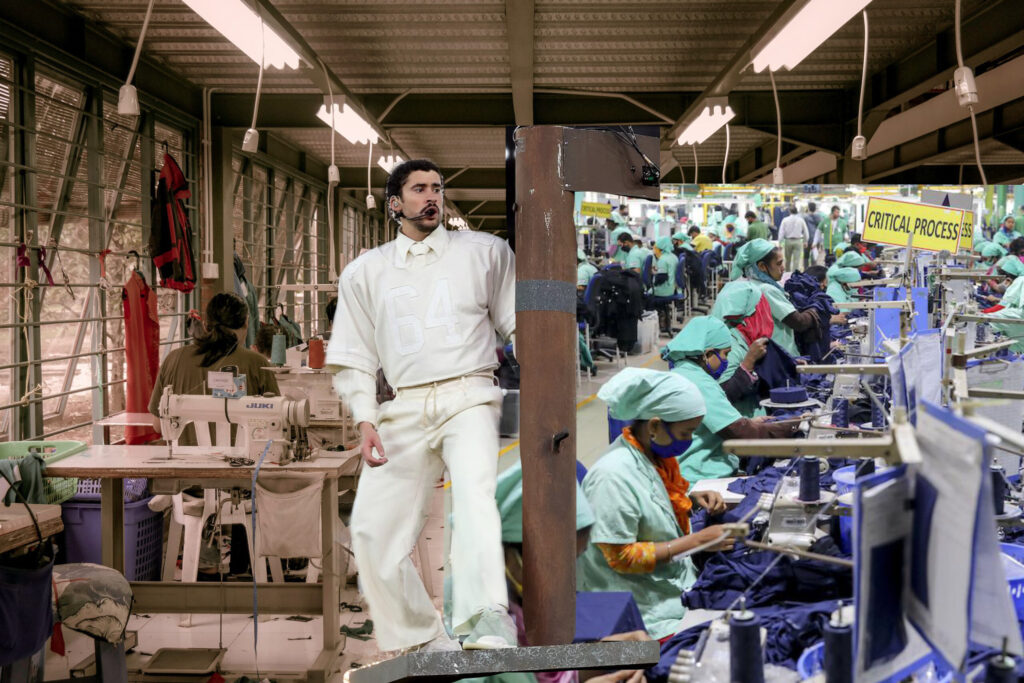
This disconnect is actually a distinction that post-colonial thought has long debated: cultural visibility increases, but economic inequalities remain unchanged. The rise of identity politics on the stage does not mean that production relations are also transforming. On the opposite, an increase in cultural representation can often strengthen the capitalist system’s capacity to reproduce itself. So, as you can see, we may not be the winning side in this game of visibility. Bad Bunny’s performance should be read in two ways for this very reason. On the one hand, he brings Latin identity to the center of global popular culture, while on the other hand, he moves forward without touching the economic structure of this center. Resistance and the market go hand in hand as the contradiction of today’s artists. This prevents the audience from fully trusting the artist. Perhaps the issue is not so much what the artist wears, but what we see. Because in modern show society, visibility is presented as a political act in itself. Yet not everything that is visible is liberating; sometimes it is merely the new face of the existing system.
I can develop a critical perspective on our dear Benito’s Super Bowl performance rather than a negative comment. Because rejecting the existing performance as it is and pointing out all these contradictions negatively would leave behind thousands of people who worked on this performance. Bad Bunny’s presence at the Super Bowl was a powerful gesture reminding us that love and equality are possible in the face of hatred. Yet, expecting artists who intend to resist through their presence to take sides is also quite a common demand in this era. We must not forget that global capitalism is a flexible and duplicitous structure, capable of inviting even its critics onto the stage.
The question in our minds may still linger. Does representation truly liberate us, or does it merely change the aesthetics of exploitation? Perhaps freedom lies in making visible the invisible labor that makes that stage possible.
written by Su Efsane Akpinar